
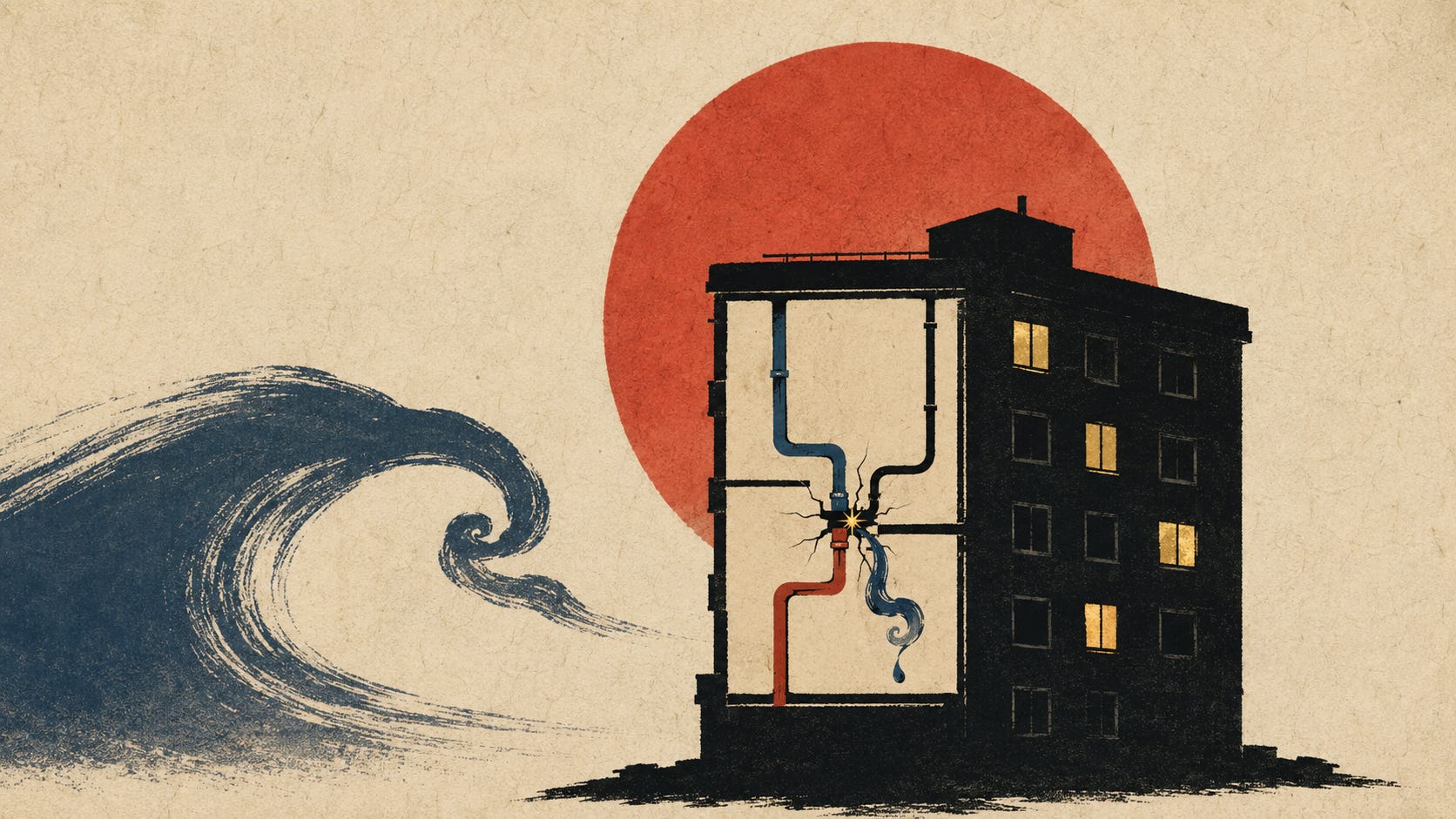
To understand what is truly happening in a world so vast and complex, imagine that you live in a large apartment building.
Every family has its own rooms, possessions, beliefs, and disagreements. Some residents are wealthy. Others are barely paying the rent. A few have been feuding for generations. What we need to ask ourselves is this: How can this small community best live together? What ensures its shared well-being? And can we extend those lessons to our global community?
There are many dimensions to these questions. In this essay, I want to focus on the everyday engineering—the furnace, the wiring, and the pipes. In this age of climate disruption, war, and political conflict, that may not seem like the most important place to focus. Nothing could be further from the truth. It is essential.
Everyone in the building depends upon the same electrical wiring, water pipes, furnace, elevators, sewer system, and delivery entrance. We take this functionality for granted because it has been central to our lives for generations. But it is precisely this functionality that is now being threatened around the world.
Imagine that two families get into a fight and begin smashing each other’s furniture. The damage may remain inside their apartments. But what if one of them cuts the power, disables the water pump, or blocks the road used by delivery trucks?
Now their fight spreads through the entire building.
Let’s stretch our imagination further. This is happening during a heatwave. The electrical system is already strained. Water use is rising. Food deliveries are becoming less reliable. Meanwhile, residents begin placing tolls and barricades in the hallways to punish one another.
Each problem may appear significant in itself, but together they place mounting pressure on the shared building, creating far more damage in combination. That is a fairly good description of the world we are entering. Curiously, the solutions are much the same for the building as they are for the world.
The signal beneath the headlines
The news presents us with an endless succession of events: a drone strikes a tanker, a port is bombed, an electrical station fails, a tariff is announced, oil rises, grain prices move, a heatwave begins.
These are the individual noises I have written about before. What we need to do is focus on what matters. The stronger signal is that the systems keeping modern civilization alive are becoming the main terrain of conflict.
This is what I mean by infrastructure war.
Infrastructure is a word that sounds remote and technical. But it simply means the systems that allow daily life to continue: electricity, water, roads, ports, fuel, communications, food distribution, banking, and transportation.
Civilization as we know it is not merely the buildings we see. It is the hidden plumbing, wiring, and countless connections that make those buildings livable.
Warfare has always attacked infrastructure. Consider, however, that today’s world possesses the most complex and integrated network of infrastructure in human history. What is different now is how tightly these systems are connected—and, to return to our apartment-building analogy, how quickly local damage can spread around the planet.
An attacker no longer needs to destroy an entire industry. It may be enough to make one shipping route too dangerous, one port too unreliable, or one electrical network too unstable. Insurance companies, investors, shipping firms, and workers may then withdraw, extending the damage far beyond the original attack.
The missile causes the initial destruction. Fear carries the damage through the system.
A war in the boiler room
The Strait of Hormuz provides the clearest current example. The feuds in our imaginary building have now escalated to the furnace that keeps it warm and the circuit breakers that keep the lights on.
Hormuz is a narrow waterway connecting the Persian Gulf to the Indian Ocean. Enormous quantities of oil, natural gas, fertilizer, and other goods pass through it. It functions like a valve in the world’s energy system.
By July 24, ship traffic through Hormuz had fallen to only about three crossings per day. Before the war, daily traffic was vastly higher. Oil briefly rose above $100 per barrel even though most oil fields and refineries remained physically intact. Reuters
The price rose because access to the oil had become uncertain.
Prices could have risen much higher, but the world’s economic systems mobilized to reduce the damage. Strategic oil reserves were tapped, oil flows were redirected, and governments and markets intervened to keep prices down. These measures carry future costs, but they were based on the hope that the war would wind down and shipping routes would reopen before those costs became overwhelming.
That hope has been badly weakened. The war has not only returned; it has expanded.
Saudi Arabia, for example, attempted to reduce its dependence on Hormuz by moving oil westward to ports on the Red Sea. Houthi forces then attacked Saudi tankers near the other end of that route. War-risk insurance costs jumped, some tankers turned around, and Saudi Arabia began looking for still other ways to reach world markets. Reuters
This is like discovering that the main entrance to your apartment building is blocked, only to find that someone is now threatening the back entrance as well.
Iran or the Houthis do not have to sink every tanker. They only need to create enough danger that shipping companies, insurers, banks, and crews decide the voyage is not worth the risk. The weapon is strategic interference in critical nodes in the system.
A port is more than a place
Unfortunately, the same pattern of disruption extends elsewhere. It is also visible in the Black Sea. And it is not only about fossil fuels. Just as critically, it is about food.
Russia has intensified attacks on Ukrainian ports, grain terminals, warehouses, and commercial shipping. Some shipowners have stopped sending vessels to Ukrainian ports. Ukraine, meanwhile, is attacking Russian oil facilities, electrical substations, ships, ferry links, and other supply routes. Reuters
This is not merely a contest over territory. Both sides are trying to weaken the systems that allow the other society to continue functioning. They are attacking the walls of the building to reach the residents within it.
A grain terminal may appear to be a collection of silos and loading equipment. In reality, it connects a farmer, a railroad, a warehouse, a ship, an insurance company, a bank, a government, and a distant family buying bread.
Damage the terminal and the effects travel through every one of those relationships.
The farmer may be unable to sell the harvest. Ukraine loses export income. Shipping costs rise. Importing countries pay more for food. Russia gains greater influence over the remaining grain supply.
People go hungry... It is a war on wellbeing.
A relatively small attack can therefore produce consequences far larger than the physical target. That is one of the defining realities of infrastructure war: the importance of a target depends less upon its size than upon its position within the system.
Climate crisis compounds the damage
While the residents of our imaginary building are fighting over the boiler room, the temperature outside is rising.
As these conflicts intensify, climate disruption places pressure on many of the same systems being damaged or manipulated by war.
NOAA reports that El Niño is strengthening, with a 97 percent chance that it will continue into early spring 2027 and an 81 percent chance that it will become a very strong event late this year. NOAA also cautions that even a powerful El Niño does not determine every storm, drought, or season. It changes probabilities. NOAA Climate Prediction Center
But those changing probabilities matter enormously.
El Niño can rearrange rainfall across much of the planet. Some regions become wetter. Others experience drought, crop losses, wildfire, or extreme heat. Roads wash out. Reservoirs decline. Electrical demand rises. Hydropower production may fall. Food production becomes less predictable.
This is where climate change matters. Human-caused warming has already raised the background temperature upon which El Niño operates. It is as though the building was already overheated before the furnace malfunctioned.
Our failure to care for the natural systems that sustain life may be the greatest ongoing infrastructure failure of all.
Now consider the connections.
War in the Gulf raises the cost of fuel and fertilizer. War in the Black Sea interferes with grain exports. El Niño threatens harvests in several parts of the world. Extreme heat increases demand for electricity and water. Floods and fires consume the public resources governments need to repair infrastructure.
No single disruption has to cause a global catastrophe. The danger comes from several forms of stress arriving together. Systems often survive one failure because another part compensates. Grain can come from somewhere else. Oil can use another route. Electricity can be imported from a neighboring region. But what happens when the alternatives are also under strain?
The signal we should be watching is precisely this convergence—the coalescing of a polycrisis.
Tariffs place tollbooths in the hallways
This crisis has been building for decades. It has contributed to the election of leaders who interpret a complex, interdependent world in stark, zero-sum terms.
Widespread and deep tariffs are one result. They add substantially to the disruption because they act upon the same networks of connection. The Trump administration has embarked upon a major reversal of the globalization policies that connected the world through a vast infrastructure of trade.
A tariff is essentially a toll placed upon a pathway of exchange. It does not necessarily stop goods from moving. It changes their price and encourages them to move through different channels. Companies look for new suppliers. Governments subsidize affected industries. Factories relocate. Countries build new trade alliances.
The question is not whether tariffs are inherently bad. It is how, where, and for what purpose they are applied.
Globalization produced inexpensive goods, but it also created profound fragility. As long as everyone participated and the major routes remained open, the system worked brilliantly at increasing the total production of wealth and resources. Its great failure was distributing that wealth fairly—a subject deserving an essay of its own.
Now that the globalization system has been challenged and weakened, its underlying vulnerabilities have become much more visible.
A country that cannot produce essential medicines, repair its electrical grid, or feed its population is not truly secure simply because it can purchase these things cheaply during normal times. When supply chains and trade routes are disrupted, nations around the world suffer.
Building greater national and regional capacity therefore makes sense. But broad and constantly changing tariffs can raise costs, invite retaliation, and place additional stress on a system already coping with war and climate disruption. In our imaginary building, the feuds are raging while tollbooths appear in every hallway. The entire building becomes harder and more expensive to navigate.
The suffering compounds.
The problems coalesce
The greatest danger is not any single war, tariff, drought, or price increase. It is the possibility that these pressures begin reinforcing one another.
War restricts energy and shipping.
Higher energy prices raise the cost of farming, manufacturing, and transportation.
Tariffs make imported equipment and materials more expensive.
Climate disruption damages crops, roads, power systems, and water supplies.
Governments borrow more to subsidize consumers, support industries, and rebuild after disasters.
These mutually reinforcing developments produce inflation and debt, leaving less money for future repairs and adaptation. People experience this complex chain of events in very simple ways: groceries cost more, electricity becomes less reliable, insurance disappears, wages fall behind, and governments seem increasingly unable to solve anything.
Political anger follows. That anger can produce even worse forms of governance.
Rather than being directed toward rebuilding common systems, it is often channeled toward migrants, foreigners, minorities, or political enemies. Leaders promise security through tariffs, harsher borders, greater military power, and still more economic confrontation.
Policies presented as protection deepen the instability they were supposed to solve.
Authoritarianism therefore becomes another dimension of the polycrisis—initially fed by instability, and then contributing to still greater instability.
Can we make the building safer?
The world is moving away from an era organized primarily around efficiency. Governments and businesses are beginning to value redundancy, resilience, and control.
Whatever we think of this transition, it is already underway. Some movement toward resilience has become necessary for survival. There are, however, two very different ways to make our shared building more resilient.
One approach repairs the common systems. It invests in distributed energy, public transportation, water security, regional food production, ecological restoration, strategic reserves, diversified trade, and strong public services.
It recognizes that genuine security comes from maintaining the conditions upon which everyone depends. The key is understanding that we share a common world and a common destiny—that we are deeply interconnected and interdependent.
The other approach allows the common systems to decay while the wealthiest residents install private generators, armed doors, private water tanks, and exclusive delivery services.
This is the zero-sum approach. It assumes that a world filled with conflict and enemies is the natural order. It is also the approach increasingly favored by many of the existing structures of wealth and power.
Both approaches may be called resilience. Only one produces a society worth living in for everyone.
If we want to move toward a better world, we must choose the first approach. That means challenging the systems that led us into this crisis. It requires imagination strong enough to overcome the fears that keep us clinging to arrangements that once worked well enough for many people, but ultimately brought us to this moment of polycrisis.
Filtering the infrastructure signal
The daily headlines encourage us to focus on individual explosions, speeches, elections, and fluctuations in oil prices. But the deeper transformation is happening in the walls of our building.
Ports, electrical grids, pipelines, water systems, shipping routes, farms, cables, payment networks, and trade rules are becoming the central terrain of power.
Military conflict attacks these systems deliberately.
Tariffs manipulate the economic pathways running through them.
Climate disruption places additional physical stress upon them.
These are not identical forces, and we should not pretend that they are. A military attack, an economic policy, and an environmental disruption carry different forms of intention and moral responsibility.
There is also deep responsibility to be assigned to the political and economic actors who have helped lead us into this crisis. But for our purposes here, these forces are converging upon the same vulnerable structures.
The strongest signal of this moment is therefore not simply that the world is becoming more violent. It is that continuity itself is becoming contested.
We should be asking:
Who can keep the lights on for everyone?
Who can move food and fuel for the benefit of the world?
Who controls the ports, pipes, cables, and payment systems—and whose interests does that control serve?
Who bears the greatest cost when infrastructure fails?
The old global order treated continuity as something that happened automatically in the background. The emerging world is discovering that continuity was the foundation all along.
We must also confront the fact that the old order, despite its successes, has brought us to a place of rapidly growing dysfunction. So remember: civilization is not the furniture. It is the plumbing. Ask yourself who is taking a sledgehammer to the walls while promising a better couch.
Who, on the other hand, are the peacemakers? Who wants to cooperate and share resources? Who understands the engineering behind the walls and wants to ensure that it continues working, rather than destroy it for some narrow, self-serving purpose?
Our choice as a world is whether we repair that plumbing together—or continue fighting in the hallways while the building around us becomes uninhabitable.
Human beings are deeply social creatures. We flourish when we collaborate, build relationships, and care for one another. We can see this clearly at the scale of an apartment building, but it applies to humanity as a whole.
We must face the reality that too many governments—and the political and economic systems supporting them—are taking us down the wrong path. We need to think differently: as global citizens committed to mutual aid, equality, shared resources, and the construction of a common world.
We live together on a fragile mote of dust in the heavens. The solutions will arise from those who value individual rights while also embracing our social nature, our shared needs, and the common good.