
When I wrote last week about the anatomy of climate disruption, my central point was that climate change is no longer best understood as a sequence of isolated environmental events. It is becoming a chain of effects moving through connected systems.
This week, that anatomy has become even clearer.
It is a little like coming down with a mysterious fever and then getting bloodwork back showing elevated white blood cells. You begin to suspect an infection or inflammation. Then a rash appears, revealing a more distinct pattern. As the symptoms accumulate, the underlying cause of the illness becomes more recognizable.
But the condition is not going away. It is becoming chronic, and our response to chronic distress is not always rational.
Climate disruptions are the hardships—the dis-ease—produced by a deeper imbalance within the Earth system. Just as when we are sick, we naturally focus on what is making us miserable. But finding a cure requires us to look beneath the immediate discomfort toward the underlying causes. The fever, bloodwork, and rash are symptoms, but they are also clues. Together, they tell a deeper and more disquieting story—a story many people do not want to hear, or feel unable to face.
The first signal is ocean heat and El Niño. June 2026 brought the highest sea-surface temperatures recorded for the month over the extra-polar ocean, according to Copernicus. NOAA now estimates an 81% chance that the current El Niño becomes very strong during the final months of 2026.
El Niño is not arriving in a neutral climate. It is emerging within a planet already carrying an extraordinary accumulation of excess heat.
A compilation of forecasts from around the world suggests that the 2026–2027 El Niño could become the strongest event in the modern record. Climate scientist Zeke Hausfather examined 667 individual model runs from 14 seasonal forecasting systems. Their model-weighted median projects Pacific temperatures in the Niño 3.4 region peaking around 3.6°C above the historical average—roughly 0.8°C beyond the previous modern record.
If that forecast holds, this El Niño will not merely break the record. It will shatter it.
There is an important caution: climate models have never been tested against an event this extreme. Agreement among models is not proof. Yet observations have continued to run ahead of earlier forecasts, and Pacific temperatures are already extraordinarily high for this stage in the event.
Beneath El Niño lies the excess energy that has accumulated in the oceans over decades. El Niño reorganizes and releases some of that heat into the atmosphere, altering weather patterns around the world. The natural cycle remains, but the background conditions within which it operates have changed.
To extend the health analogy it isn’t just a fever, it’s a fever on top of chronic inflammation, caused by an underlying condition — in this case, two centuries of human activity and the burning of fossil fuels.
The second signal is wildfire.
Spain is experiencing its largest wildfire of the year. The La Mierla fire has burned more than 26,000 hectares and forced more than 1,000 people from their homes. At the same time, Spain’s third heatwave of 2026 is pushing temperatures in some areas toward 42–44°C. More than 104,000 hectares have already burned across the country this year.
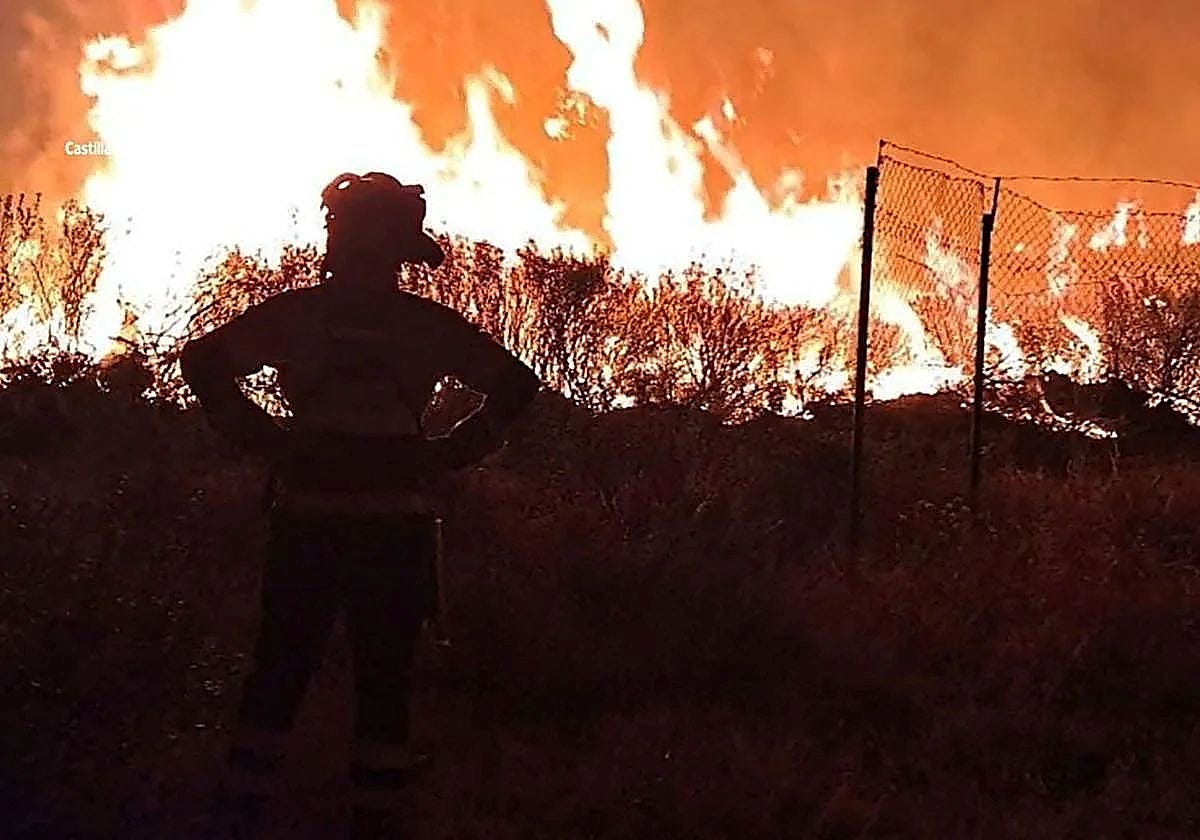
What lies behind these fires—not only in Spain, but across much of the planet, particularly at higher northern latitudes?
Climate change does not ignite most fires. Lightning and human activity do that. But climate increasingly determines how easily vegetation burns, how rapidly fires spread, and how difficult they are to contain. Higher temperatures increase the atmosphere’s demand for moisture, drying soils and vegetation where moisture would otherwise buffer fire risk. Heat, drought, wind, fuel conditions, land management, and ignition then interact.
The Arctic and sub-Arctic are warming especially rapidly, and fire regimes in many high-latitude regions are responding. Wildfires in North American permafrost regions have increased since the middle of the twentieth century, while recent years have produced exceptionally high wildfire emissions north of the Arctic Circle. The exact pattern varies by region, but the broader direction is troubling.
The third signal is smoke, perhaps the most intimate expression of wildfire’s expanding reach.
Wildfire smoke is becoming one of the clearest ways people experience climate disruption directly. Smoke collapses distance. A fire hundreds or even thousands of miles away becomes visible in the color of the sky, the smell of the air, the cancellation of outdoor events, the worsening of asthma, and the quiet calculation of whether it is safe to take a walk.
This is climate disruption entering the lungs.
It is becoming more personal, and the reactions are mixed.
The same warming that increases drying and wildfire risk in some places can intensify rainfall in others. A warmer atmosphere can hold about 7% more water vapor for every degree Celsius of warming. That does not guarantee that every storm will become more intense, but it means that storms can draw upon more moisture when the necessary atmospheric conditions come together.
Climate change is intensifying the water cycle, producing both heavier rainfall and deeper drying in different places—and sometimes within the same region.
The fourth signal is flooding.
Texas, as one example, has again faced dangerous floods, with heavy rainfall, rescues, damaged homes and businesses, and renewed stress on roads, bridges, warning systems, emergency workers, and local governments. Recent flooding damaged roughly 600 homes and 100 businesses in Kerr and Kendall counties, while emergency crews rescued more than 530 people.
It is not that Texas has never flooded before. It has. The point is that a warmer, moisture-laden atmosphere increases the potential for extreme rainfall. When that rain falls in the wrong place, at the wrong intensity, it rapidly becomes a human, infrastructural, economic, and governance crisis.
For an individual, illness is not only about the fever or even the disease itself. It can mean lost work and income, time taken away from friends and family, diminished independence, and a mental toll that contributes to depression and anxiety. With chronic illness, these losses compound. People cope in different ways, and not all of those responses are healthy.
One of the central patterns of climate disruption is that the weather event is only the beginning. The full impact becomes apparent as the event moves through the systems people depend upon, often creating prolonged and chronic stress.
A flood becomes damaged roads, displaced families, emergency spending, insurance claims, lost work, political pressure, and arguments over preparedness. A fire becomes smoke, health risk, evacuation, destroyed property, exhausted firefighters, higher insurance premiums, and public grief. A heatwave becomes hospitalizations, labor strain, power demand, crop stress, and premature death.
The signal is not simply that extremes are happening. The signal is that extremes are linking, moving across systems, and causing disruption throughout nearly every realm of life.
Ironically, this expansiveness can obscure the pattern as readily as it can reveal it. The same disruption that should produce urgency can instead produce exhaustion, denial, and resignation.
Think about people who live difficult and challenging lives because of chronic illness. After a while, the hardship can become background. A reduced quality of life begins to feel normal. Hopes of finding a cure rise and collapse, one after another. Eventually, hope itself can begin to feel dangerous.
Some people stop looking for solutions. Some retreat into denial. Others channel their pain into anger and blame—anything that allows them to avoid confronting a condition that feels overwhelming.
Societies can develop analogous coping responses. Prolonged disruption can encourage adaptation and solidarity, but it can also produce avoidance, resignation, displaced anger, scapegoating, and the search for simple answers to systemic problems.
Climate hardship is becoming chronic. I think one consequence is a psychology that can work against climate action. People normalize the disruption, turn away from overwhelming information, or redirect their fear and anger toward simpler targets.
The political data reveal a complicated version of this response.
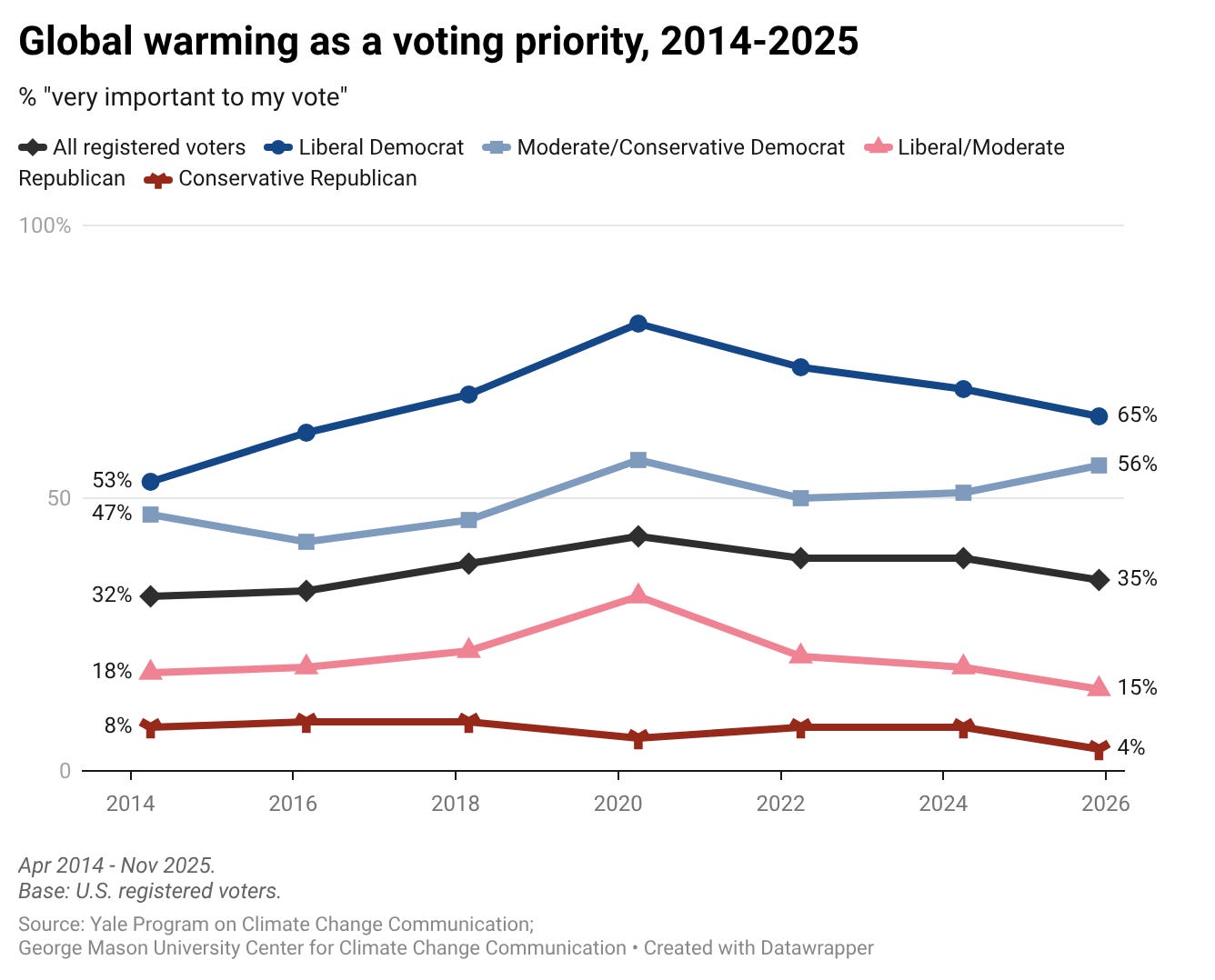
The chart does not show a simple collapse in public concern. In fact, climate change remains a more important voting issue for several groups than it was in 2014. Moderate and conservative Democrats, for example, show higher concern than they did a decade ago.
But it also shows something more troubling.
Climate change rose as a voting priority through 2020 and then declined among most groups, even as its physical effects became more apparent. At the same time, the divide between liberal Democrats and conservative Republicans widened dramatically.
The physical signal is becoming clearer while our collective ability to respond is becoming more fractured.
That is one reason knowledge matters in the case of climate disruption. As a society, we have often failed to see these patterns clearly, allowing them to become normalized as background disorder. The resulting psychology can move in many directions: defeatism, displaced anger, denial, scapegoating, or the search for simple answers to systemic problems.
Those reactions have also been exploited. Fossil-fuel interests and allied political networks have a well-documented history of funding climate obstruction, delay, and disinformation. Increasingly, climate action is portrayed as an attack by distant elites upon ordinary people, while fossil-fuel extraction is presented as synonymous with national identity, freedom, and economic security. Researchers have described this strategy as “carbon populism.”
That does not mean that everyone who resists climate action is consciously serving fossil-fuel interests. Nor does it mean that climate hardship alone explains political polarization. Partisan identity, economic insecurity, competing priorities, and institutional distrust all matter.
But genuine fear, loss, and insecurity can be redirected away from underlying causes and toward convenient scapegoats. The psychology of disruption becomes political energy.
Focusing on the deeper dynamics of climate change can help break that spell. The underlying patterns do not end with atmospheric science. They extend through culture, economics, politics, public health, and personal experience.
But knowledge is only the beginning of agency. If understanding does not move outward into preparation, policy, adaptation, mitigation, and collective responsibility, then it remains only latent awareness.
The task is to understand the anatomy of climate disruption clearly enough to break through a psychology and politics of defeatism. We can then act within these deeper patterns—locally, politically, economically, and personally—to move ourselves and society toward real change.
The time to avoid all damage has passed. But the future remains pliable. There are still enormous differences between the futures available to us.
The question now is whether we learn from the deeper patterns soon enough to reduce the damage, protect the vulnerable, and choose a more livable path.
Climate clearly bears many similarities to pandemics in the sense that it impacts everyone's lives while the response varies widely. In the past I've always tended to separate the physical impacts from the psychological responses. But it's becoming clear to me now that with any public health or environmental crisis, many human beings respond in ways that compound the crisis.
One primary response is rumor-mongering. Both climate and pandemics are existential threats. And various forms of denial tend to provide temporary relief. They allow people to try to continue to conduct business as usual. The other thing that happens is that sometimes there's an overcompensation in the opposite direction. For example, during covid, various religious groups deliberately held services with unmasked people which became super spreader events. With the climate, some people respond with conspicuous consumption "proving" that things are still normal and there's no crisis.
In both cases, there tends to be immediate feedback. With pandemics, people die. With climate, the loop is longer, but a cooler climate remains in living memory. Coal rolling trucks coexist with wildfire smoke resulting from conditions brought about by earlier emissions.
Both responses tend to create a false sense of invulnerability and a temporary feeling of control over forces much larger than humans. Vaccine and EV refusals occupy the same psychological space. "No one tells me what to do." It's very funny because some of the people most invested in denial are the most obedient to both human and divine authority figures. It's an abstraction mismatch. They comply with personal authority, but refuse to acknowledge physical systemic authority.
This also tracks with what I've referred to as dilution of empathy. People get very concerned about a single high-profile case like the shooting of an innocent person by authorities. But they seem oblivious when it comes to the regular grinding deaths from poverty and hunger among children.
It's all predictable primate behavior for a species that evolved for life in small groups rather than a global civilization. The same mechanics that make us hostile to out groups also make us hostile to mentally engaging with large unseen forces far outside the village.