
The Surface of Things
We have been taught to see the world as simply a whole bunch of things connected together. When we try to make sense of events, like the effects of a recent war or geopolitical crisis, we focus primarily on barrels of oil, fleets of ships, military assets, or market prices. When we try to understand the climate and the environment, we think of forests, storms, oceans, heatwaves, and fires.
In all our deliberations, in all our wonderings about the world, we usually start with a body, a person, a nation, or a market.
This way of seeing is not entirely wrong. Things do exist. A tree can be cut down. A tanker can be tracked. A person can get sick. A price can rise. A temperature can be measured. But this way of seeing is increasingly limited. And in a time of climate instability, geopolitical stress, and personal exhaustion, its incompleteness is becoming downright dangerous.
The deeper truth is that the world is made of relations. Reimagine things as temporary forms that emerge from continuing relationships, and the world begins to make a lot more sense.
A forest is not just trees. It is sunlight, soil, roots, fungi, microbes, insects, water vapor, rainfall, carbon, shade, temperature, and time, all held in a living pattern.
A human being is not just a body. A person is breath, food, memory, nervous system, family, sleep, community, meaning, metabolism, language, emotion, and place.
A global economy is not just commodities. It is ports, ships, canals, straits, insurance contracts, currencies, fuels, fertilizers, semiconductors, military guarantees, weather patterns, credit systems, and trust.
Here is a key insight: reality is relational before it is mechanical. A tree arises out of relationships in nature: the way the landscape folds, precipitation falls, seeds are dispersed, roots communicate, and oxygen, carbon, and nitrogen cycle.
Call it “thing bias”: the habit of treating visible objects as more real than the relationships that sustain them.
Now, this naming can feel abstract, maybe even meaningless to many people. It runs against centuries of thing bias. That is, until something breaks. Then the hidden relations become visible, and with some effort, the deeper pattern starts to make sense. That is the moment we are in. Things are breaking, and this creates an opportunity to envision the nature of reality itself anew, to see the world with a fresh and necessary perspective.
Consider El Niño
To many people, El Niño sounds like a weather event. Warm water appears in the Pacific, and strange weather follows. But El Niño is not really a thing in that simple sense. It is a reorganization of relationships across the tropical Pacific Ocean and the atmosphere above it.
Under more neutral conditions, trade winds push warm surface water toward the western Pacific. Cooler water rises along the eastern Pacific. Rainfall concentrates in familiar tropical zones. The ocean and atmosphere cooperate in a pattern that has global consequences.
During El Niño, this pattern shifts. Warm water spreads eastward. Upwelling weakens. Trade winds slacken. Clouds and rainfall move. We can see this phenomenon with fresh eyes: heat that had been organized one way becomes organized another way. It is this change in circulation that alters how things relate to each other and causes global weather disruptions.
El Niño testifies to the fact that climate impact is not just a question of how much heat exists. It is also a question of where heat goes, where rain falls, where drought intensifies, where crops fail, where fisheries decline, where fires become more likely, and where governments are forced to respond.
El Niño reveals something fundamental about this new way of seeing things. We often think of stability as stillness. But in living systems, stability arises from successful movement.
A healthy climate system is not one where nothing changes. It is one where change remains coherent enough for life to adapt. Rainfall comes within expected bounds. Growing seasons remain recognizable. Oceans absorb and redistribute heat. Forests recycle moisture. Soils retain water. People plant, harvest, build, migrate, trade, and plan within a range of conditions they can understand.
But when the background climate warms, and when forests, soils, aquifers, coral reefs, wetlands, and food systems are already stressed, a strong El Niño becomes more than a natural oscillation. It becomes a stress test. It reconfigures relationships. In normal circumstances, these changes are temporary. Nature is resilient and normality rebounds. But today, enhanced by climate change, the question arises: how much resilience is left?
That is an uncomfortable question. El Niño in a warming world exposes vulnerability that was already there. It reveals where continuity has been weakened. It can push stressed systems toward new and lasting configurations, especially when forests, reefs, soils, food systems, and political institutions no longer recover fully between shocks. What once shifted back may now shift into uncharted territory.
The flow of nature in a changing climate expresses itself like a river experiencing more water flow. Imagine the rising water and churning eddies cutting new channels. When the flow returns to normal, where will the water now go? Now imagine that flow ever-increasing. Imagine El Nino as an extra burst.
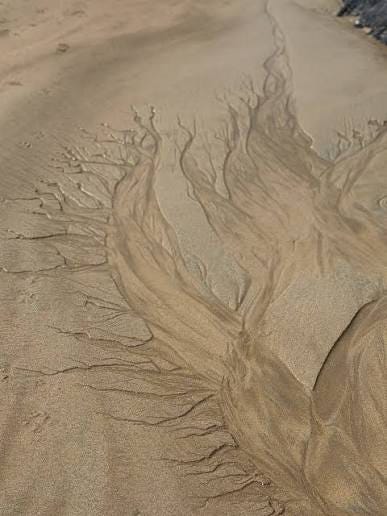
This is the relational view. Events do not strike collections of things. They strike systems of connection. Let’s look at nature that way. We are a part of it.
A drought is not only a lack of rain. It is also a test of soil depth, vegetation cover, groundwater storage, agricultural diversity, public planning, household income, and political trust. A flood is not only too much water. It is also a test of wetlands, drainage, zoning, infrastructure, insurance, emergency management, and whether a society has respected the memory of its own landscape. A heatwave is not only temperature. It is housing quality, tree cover, labor conditions, medical access, electrical grids, age, illness, and social isolation.
Now Consider Global Trade
The Strait of Hormuz is a narrow passage of water between the Persian Gulf and the Gulf of Oman. On a map, it looks like a geographic feature. In ordinary language, it is a “chokepoint.” But that word does not go nearly far enough. It does not fully reveal the relational nature of the global economy.
The Strait of Hormuz is not simply a route through which oil and gas move. It is a major artery in the circulatory system of industrial civilization. It is not just oil, liquefied natural gas, fertilizer inputs, and petrochemicals that move through this narrow geography. It is shipping schedules, Asian energy security, military strategy, insurance markets, food prices, and diplomatic pressure. What passes through this narrow geography is a web of interconnections that shapes our world.
When shipping through such a chokepoint is disrupted, the crisis is not only that fewer barrels move. The crisis is that those relationships lose reliability and cohesion. It too is a stress test. Will these vital connections reestablish themselves, or are we seeing the birth of new configurations? What has happened to the river?
A tanker may still exist. Oil may still exist underground. Ports may still exist. Refineries may still exist. But if ships cannot safely pass, if insurers raise rates, if navies reposition, if contracts become uncertain, if buyers begin hoarding, then the resource has changed in its practical meaning.
The object remains, but the relation fails. With that failure, things fall apart and reconfigure.
A massive fire burns a forest down. What happens next? Does it grow back and mature as it once did, or does it turn into savanna or desert? If the relations between climate, water, soil, seed, and atmosphere have changed, the system is likely to shift into something new.
Of course, humanity reacts as it tries to manage things. We see how prices can rise before physical scarcity is absolute. Markets are not merely reacting to present supply. They are reacting to damaged confidence in future continuity. Then key actors intervene in that psychology. Governments draw down reserves. Central banks alter lending rates. Treaties are signed. Money is printed. Naval forces are repositioned. Traders are reassured… Leaders try to keep things as normal as possible, hoping the disruption subsides.
But the deeper assumption is that the old relations can reassemble, that no new channels have been dug by the raging waters.
That is another stress test. We shall see. We are already witnessing new configurations: nations shifting energy strategies, governments reconsidering supply chains, and markets recalculating risk.
The food system is also being tested. It relies on surplus to maintain food security. Food is not simply grain in a field. It is diesel, fertilizer, rainfall, soil, credit, labor, refrigeration, shipping, roads, ports, storage, currency stability, and household income. Restrict energy flows and you can raise fertilizer costs. Raise fertilizer costs and you can lower yields. Lower yields and you can raise food prices. Raise food prices and governments experience pressure. If reserves are already thin, societies become more vulnerable.
The chains are not linear. They are relational. The effects are not merely causal in the simple sense. They are ecological, web-like, interdependent, and always about flow.
When you watch a river cut a new channel, when you observe branches and eddies form, you are observing something about the nature of reality. What causes a channel to form here and a swirl to appear there cannot be reduced to one simple cause. It is interaction. It is complexity. It is emergence. A disruption in one place, even something quite small, can vibrate through distant systems. It can augment. It can gather strength.
The modern world, like the flow of a river, is made of interdependencies that we often pretend are separate. The relations are invisible. Surpluses create complacency. The system appears to run itself. The supermarkets are fully stocked. The ports operate. The ships pass. The power comes on. Then a conflict near one waterway, or shifting currents in far-off oceans, begins to affect a family buying groceries thousands of miles away.
The river forms new eddies. Rivulets turn into new channels. Water flows in new ways.
Seeing Objects and Not What Lies Beneath
Modern institutions are very good at measuring objects. We classify things. In fact, that is the very heart of bureaucracy. The word bureaucracy comes partly from bureau, a desk or office. It is rule by filing cabinet. We file the number of barrels, the count of dollars, the amount of carbon in the atmosphere, acres in a region, jobs in an economy, and quarterly returns in a corporation.
This is useful. But it creates a bias. What can be counted becomes visible, whereas many critical things, not easy to count, are dismissed. What sustains continuity often remains invisible.
A forest may appear economically underproductive until it is gone and the rains change, the soil heats, the flood risk rises, and the aquifer declines.
A healthy body may appear unremarkable until sleep collapses, inflammation rises, anxiety spirals, digestion fails, or chronic pain appears.
A stable trade route may appear boring until it is mined, blockaded, threatened, or priced out by risk.
A loving relationship may appear ordinary until trust is broken.
The greatest systems are often composed of what is largely unobservable, uncountable, and latent. That is why it can look like nothing is happening when they are actually preventing breakdown. But ignore and undermine these elements, and everything changes.
Thing bias is one of the great failures of our age.
It is the activity of the world that is simply taken for granted.
A functioning immune system is active.
A stable friendship is active.
A living soil is active.
A peaceful border is active.
A navigable strait is active.
A predictable monsoon is active.
A calm mind is active.
The fact that these systems do not always announce themselves does not mean they are doing nothing. It means they are ostensibly working “in the background.” But they are not really the background. They are the reality itself. Continuity, whether it involves trade flows, climate stability, public health, or personal peace, relies on the successful regulation of these relationships.
The ontological shift I think we need has already begun, through focusing less on things and more on activities. That is what the science of ecology did, and many other disciplines have followed. Perhaps we are also seeing a concominant change in human consciousness, though it is messy and conflicted.
Health and Wellness
The same relational logic applies to personal life, and the way we see our own lives has changed in fundamental ways.
It has become common sense to think that human beings do not flourish by accumulating more things. More money may help. Better housing may help. Good food may help. Medical care may help. But none of these works in isolation.
We are beginning to understand that health itself is fundamentally relational. It emerges from sleep, movement, nourishment, emotional safety, meaningful work, sunlight, social connection, nervous system regulation, clean air, clean water, memory, purpose, and love.
In our thing-focused society, a person can look externally successful. They may appear to have all the things necessary for a good life, while the deeper relations that sustain life are fraying. We know this now. A person may have a job, a house, a phone, a car, and a bank account, yet feel profoundly unwell. Why? Because the visible objects are not enough. The invisible relations may be broken.
We can buy and take more things. We can achieve more accolades. We can optimize our lives and create efficiencies. Sometimes that helps. Often it does not. Because what is needed is not merely another object or intervention. What is needed is restoration and maintenance of healthy relation. We already know,
to flourish is not simply to possess more. It is to participate in healthier patterns.
This is also why metacognition matters. Metacognition means noticing how we are thinking, not just what we are thinking. It allows us to ask: What frame am I using? What am I treating as real? What am I ignoring because it is hard to measure?
When we apply metacognition to our personal lives, we begin to see that many of our struggles are not failures of willpower. They are failures of relationship. How am I sleeping? What am I eating? Are these things supporting my recovery after a hard day? Are they restoring my body? Whom am I connected to, and for what reasons? Where am I spending my attention, and what am I ignoring that I should not ignore? Are my efforts in life promoting continuity and regulation? In other words, are they restorative?
These are ecological questions. The self is not separate from its environment. As a community, we are beginning to understand that human life is an ecology.
A Relational Civilization
And if this is true at the personal level, it is also true at the civilizational level. A mature civilization would not ask only: how much can we extract? It would ask: what relations must remain healthy for extraction, production, trade, culture, and human flourishing to continue at all?
It would not treat forests merely as timber or carbon. It would treat them as hydrological infrastructure, climate regulators, living archives, and participants in rainfall.
It would not treat oceans merely as shipping surfaces or fish supply. It would treat them as heat reservoirs, climate engines, food webs, and planetary memory.
It would not treat workers merely as labor inputs. It would treat them as embodied lives whose health, families, attention, and dignity shape the real economy.
It would not treat trade routes merely as lines on a map. It would understand them as relations of trust, geography, security, energy, and time.
It would not treat climate policy merely as emissions arithmetic. It would ask whether each decision strengthens or weakens the living systems that buffer heat, move water, grow food, and preserve continuity.
That it still does all those things is more a reflection of past structures and ideologies that no longer serve us.
The Continuity Test
Here is a simple test for any personal, political, economic, or ecological decision: Does this strengthen continuity? Does it deepen the relations that allow life to keep renewing itself?
For land, that means asking whether we are improving soil, vegetation, water retention, biodiversity, and local climate resilience.
For trade, it means asking whether we are building redundancy, fairness, regional capacity, and peace, or merely maximizing efficiency until one broken artery threatens the whole body.
For climate, it means asking whether we are reducing greenhouse forcing while also restoring the water, forest, ocean, and soil systems that regulate planetary life.
For personal health, it means asking whether our habits restore the relations that allow the body and mind to heal.
For society, it means asking whether our institutions increase trust, meaning, competence, and shared reality, or whether they consume those things while pretending to create wealth.
So here is the lesson: a system survives by maintaining the relations that make its survival possible. A system thrives by nurturing the right relations and by restoring necessary broken ones. To get there, the old must be challenged and overcome.
Closing Thoughts
The world we see is made of objects, true, but the deeper world is made of relations. A storm, a forest, a market, a body, a mind, a civilization: these things are all constructed through relation.
When those relations are healthy, life feels ordinary. Rain falls. Ships pass. Food arrives. Sleep comes. Trust holds. The body heals. These are all qualities that we cannot simply take as background, as if they go on without support. We should learn that these qualities need to be nurtured directly.
When those “background” relations fail, the ordinary becomes precious. Then we notice things we may never have noticed before. We notice that what we simply took for granted is suddenly faltering.
This is why the crises of our age feel so strangely connected. Climate instability, supply chain shocks, loneliness, chronic illness, political distrust, ecological degradation, and economic anxiety are not identical problems. But they rhyme. They emerge from systems that have mistaken throughput for flourishing and objects for reality.
We have become highly skilled at moving things while becoming less skilled at preserving the relations that make movement meaningful.
The great task ahead is not merely technological, economic, or political. It is perceptual. We must learn to see the world beneath the world: the invisible patterns that allow life to continue. The good news is that this shift in consciousness appears to be rising, unevenly, with tension and uncertainty, but rising nonetheless.
An immature society waits until continuity fails, then calls the emergency response “growth.” How are we trying to solve the climate crisis? By building a new green energy system. That is necessary. But alone, it will not guarantee success. In fact, without changing the deeper structure of our civilization, it will most likely fail.
The change we need is not only about ideology. It is about what is real. It is about whether we understand what kind of reality we are living in. Until we do that, changing the things in our world, from internal combustion vehicles to electric vehicles, without challenging the deeper logic of growth and profit, simply will not be enough.
Our challenge is rooted in our thinking, in ourselves, and in our institutions. Humanity must evolve beyond extraction, production, and profit as supreme values, and beyond great concentrations of wealth and power as signs of success. It must find a way toward a distributed and relational future, one that looks much more like the flows of an ecosystem than the capital structures of a top-down corporation.
The object remains, but the relation fails.
The future will not be secured by changing objects alone, while maintaining old structures. It will depend on whether we can restore the relations that allow forests, bodies, communities, economies, and civilizations to remain alive. And that restoration will require new thinking and action.
This is such a great analysis and you write beautifully. Things are nodes, and relations are the network. Ignoring either part means lack of crucial awareness of the world. I'm also constantly trying to get people to view the world as a nested system of systems. But it's an uphill battle.
Something as mundane as flipping a light switch means we are interacting with essential systems that the vast majority of people have no knowledge of. Sadly a lot of them like it that way. Then one day the light switch doesn't work or the faucet is dry and the cumulative burden of non-awareness turns to impotent rage.
If only “Do unto others as you would have done to you.” was the law of the land. One can deny climate change right up til you’re sandbagging around your house or hosing the roof down as the 80 mile an hour winds are driving the municipal conflagration right down on you.