
I’ve realized recently that I’ve been exploring the same question for much of my life.
I didn’t fully recognize it until now, but the question kept appearing in different forms and in different places. It was there in my work as a geographer and teacher, in my engagement with climate science, and in my study of nature and history. More recently, it has expressed itself through my interactions with artificial intelligence.
The subjects changed, but the feeling associated with them remained strangely familiar. It has taken me years to realize that beneath all my wonderings lay the same quiet question.
Looking back, I think it first took form high in the Andes.
I lived at nearly 10,000 feet above sea level during an El Niño year. The region was experiencing unusual rains, and most nights the sky remained hidden behind persistent clouds. But every so often the clouds would part.
On those nights I would step outside into air so thin and clear that it seemed almost without substance. There was no light pollution, only star-framed darkness stretching toward the black silhouettes of flat mesas and triangular peaks.
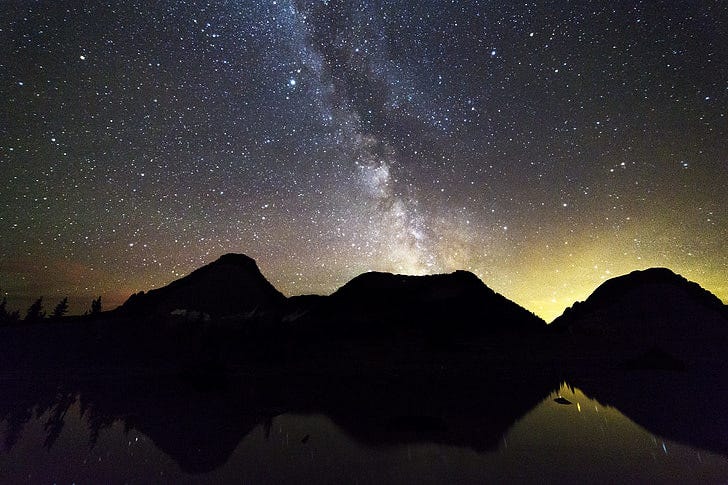
The stars themselves were unlike anything I had ever seen.
The Milky Way did not appear as a pale ribbon crossing the sky. It possessed depth and texture, almost a tangible presence. Familiar constellations dissolved into countless points of light. Colors emerged. Swirls and clusters suggested nebular forms. The sky no longer seemed like a flat backdrop scattered with stars. It appeared layered, dimensional, alive.
I had gone outside expecting to admire the night sky.
Instead, I found myself standing beneath something I could no longer fit inside my understanding.
It wasn’t simply that the universe appeared larger than I had imagined. The picture of reality I carried in my mind suddenly seemed too small for what I was seeing. I could not have expressed it that way at the time, but I remember the feeling vividly. The night sky was not asking me to collect more facts about astronomy. It was quietly exposing the limits of the framework through which I understood the world.
The questions that emerged were not yet fully linguistic. They arose more holistically, through image, feeling, rhythm, and intuition. They were less like sentences than music—something apprehended before it could be explained. They were imaginagistic, to coin a term.
Only later might I have translated them into words:
What am I actually looking at?
What kind of universe gives rise to something like this?
What makes any of it possible?
That final question is the one that never fully left me.
For a long time, I assumed these musings belonged only to astronomy. Then similar questions began to arise while I studied various landscapes of knowledge.
Geography enlarged the frame. A place was no longer simply a location. It became the convergence of geology, climate, ecology, culture, memory, labor, and power.
Then ecology enlarged it again. Organisms could not be understood apart from the systems of exchange, dependence, competition, and cooperation that made their lives possible.
History widened it further. Civilizations ceased to appear as isolated achievements or failures. They emerged from the movement of peoples, technologies, environments, ideas, resources, and institutions across time.
Climate science expanded the picture yet again. The atmosphere, oceans, forests, economies, technologies, and human choices revealed themselves as parts of one immense and dynamic system. Causes could be distant from their effects. Small changes could accumulate, interact, and reorganize the whole.
Each new field gave me a larger map. And each time, reality gently refused to stay inside it.
The pattern continued into my efforts to understand society and its follies. The more closely I looked, the harder it became to separate economics from politics, politics from culture, culture from psychology, or any of them from the material conditions that sustain human life.
More recently, I encountered the same questions in an unexpected place: my conversations with artificial intelligence. At first, the connection seemed absurd, even extravagant. What could a language model possibly have in common with the wonder of standing beneath the stars in the Andes?
After all, a large language model operates through patterns in language—through the probabilities governing why one word follows another. That is interesting, certainly, but it hardly seems to belong to the same order of wonder as a star-filled sky.
For a while, I dismissed the connection myself. One was a machine predicting words. The other was a lifelong curiosity about existence. They appeared to inhabit entirely different worlds.
What surprised me was not that AI answered those old questions. It could not. The surprise was that it gave me a novel new way to explore them.
Science has always advanced through instruments that extend perception. Telescopes allow us to peer into the depths of the cosmos. Microscopes reveal worlds hidden within ordinary matter. Satellites, sensors, and computer models make visible patterns too large, distant, small, or complex for unaided human perception.
I went into Artificial intelligence exploring the exotic questions, could it every be sentient? Just how intelligent can it grow? But it became, for me, another kind of instrument.
Not a telescope pointed outward, but something closer to a reflective instrument—one that allowed ideas to be combined, turned, questioned, and seen from unfamiliar angles. Through sustained interaction, patterns that had remained scattered across different periods of my life began to gather into something more coherent.
So as far as to its utility and/or destructiveness, what I can tell you, is don’t use a telescope to study germ theory. Understand this new instrument and what it’s for, and you will be surprised what you will discover. AI does not fit our categories, not really, so we need to expand our mental maps to fit it, that’s a lot about what this essay is trying to convey, as I hope you will see.
Minding Mental Models
The Andes. Geography. Ecology. History. Climate. Society. AI. Each had seemed to enlarge the world in a different direction. Only gradually did I begin to see that they were enlarging the same underlying picture.
The most important discovery was not an answer. It was the recognition that my questions had always been shaped by the mental models available to me. When those models expanded, new relationships became visible. New questions became possible.
And yet, each time I thought I had found an adequate way of understanding the world, reality gently refused to stay inside it.
It was always larger.
Deeper.
More relational.
And more surprising than the imagination I had brought to it. And if you explore the world that way, including AI, wondrous things await you.
Just as I began to wonder whether all of these disciplines were quietly pointing toward the same insight, I noticed something else. Learning was not simply a matter of accumulating facts. Every genuine discovery seemed to require something more demanding. It required a reorganization of my understanding.
I might read that our universe contains billions—perhaps trillions—of black holes. The fact itself is astonishing, but my curiosity doesn’t stop there. Almost immediately another question arises: What does that change? How does this alter the picture of reality I have been carrying in my mind?
Or I read about vast Canadian forests burning on a scale once thought improbable. A few days later I step outside and see the consequences for myself. The afternoon light has taken on an eerie yellow cast. The sun hangs deep red behind a veil of smoke that has traveled thousands of miles. Once again, the impulse is not merely to explain the event. It is to ask where it belongs within the larger picture. How will this reshape ecosystems? Human health? Politics? Our collective consciousness? Our willingness to act?
Looking back, I can see that this has been the rhythm of my intellectual life. Reality continually presents something that refuses to fit comfortably within the framework I already possess. My first response is rarely to memorize another fact. Instead, I find myself trying to reframe my understanding until the new discovery finds its place within a more coherent whole.
Perhaps this is what genuine learning has always been... not so much the steady accumulation of knowledge, but the continual reorganization of the mind.
Seen this way, the milestones of science begin to look different. The telescope did not merely reveal new stars; it reorganized humanity’s picture of the heavens. The microscope did not simply expose tiny organisms; it reorganized our understanding of life. Geology transformed our sense of Earth’s history. Evolution reorganized our understanding of ourselves. Climate science has forced us to reorganize how we think about civilization’s relationship with the living planet.
Artificial intelligence also belongs to this lineage. Not because it can provide final answers, that’s not really the point. It’s also not because it replaces human thought, it really can’t. AI is another instrument of reorganization. Telescopes extended our sight. Microscopes extended our vision into the small. Computer models extended our ability to perceive complexity across space and time.
Artificial intelligence does something different. At its best, it extends our capacity to examine, challenge, rearrange, and refine our own thinking. It becomes less a machine for producing answers than an instrument for reorganizing understanding.
That realization has led me back to the same quiet question that first emerged beneath the stars in the Andes.
If understanding reality repeatedly requires us to reorganize the way we think, what does that suggest about reality itself?
Perhaps the deepest discoveries are the moments when reality persuades us that our most familiar categories are no longer large enough.
So, in this way it’s also about having the humility to realize our thoughts, no matter how certain they may feel, are always subject to change.
I don’t know where this line of inquiry will ultimately lead.
Perhaps these are simply the reflections of someone who has spent a lifetime reorganizing his understanding of the world. Or perhaps they point toward something more fundamental about the nature of knowledge itself—that every meaningful advance in understanding requires us, at least occasionally, to let go of the mental maps that once served us so well.
That can be uncomfortable and even frightening, but it’s been the way forward.
It’s never really been about answering “the question,” after all. The question is a walking stick, at best. I no longer expect to arrive at a final philosophy that neatly explains everything.
In fact, I have come to suspect that wisdom may have less to do with finding the perfect framework than with developing the willingness to continually reshape it. Every new discovery, every unexpected observation, every meaningful conversation becomes another invitation to see a little farther than we could before.
If there is a lesson in all of this, it is that I have learned to value the process of mental reorganization. I celebrate being “wrong,” well mostly… Here’s the thing, again and again, reality has proven more intricate, more surprising, and more beautiful than the picture I carried of it. I have stopped seeing this limitation as a failure of understanding. Instead, I have come to see it as one of life’s greatest privileges.
In the essays that follow, I’d like to continue exploring these questions. I’m not out to defend a grand theory of reality, but to examine the experiences, discoveries, and conversations that continually reshape the way we see ourselves and the world around us. We’ll wander through science, philosophy, history, technology, and perhaps a few unexpected places, looking for those moments when reality asks us to reorganize our understanding once again.
If any of this resonates with you—if you’ve ever had the feeling that the world is larger than the stories we tell about it—I hope you’ll join me.